- What Is Artificial Intelligence in Project Management?
- Why Businesses Need AI in Project Management
- The Relationship Between AI and ERP Systems in Project Management
- How Automation Supports Project Management
- Key Applications of AI in Project Management
- The Role of ERP in Connecting Projects with Business Operations
- Accounting and Financial Reporting
- Procurement and Supplier Management
- Inventory and Warehouse Management
- Human Resources and Payroll
- Invoicing and Sales
- AI vs. Automation: What's the Difference?
- Benefits of AI in Project Management
- Reduced Administrative Work
- Better Decision-Making
- Fewer Human Errors
- Complete Project Visibility
- Higher Productivity
- Stronger Operational Control
- How Manzuma Helps Businesses Manage Projects Intelligently
- Start Managing Projects Smarter with Manzuma
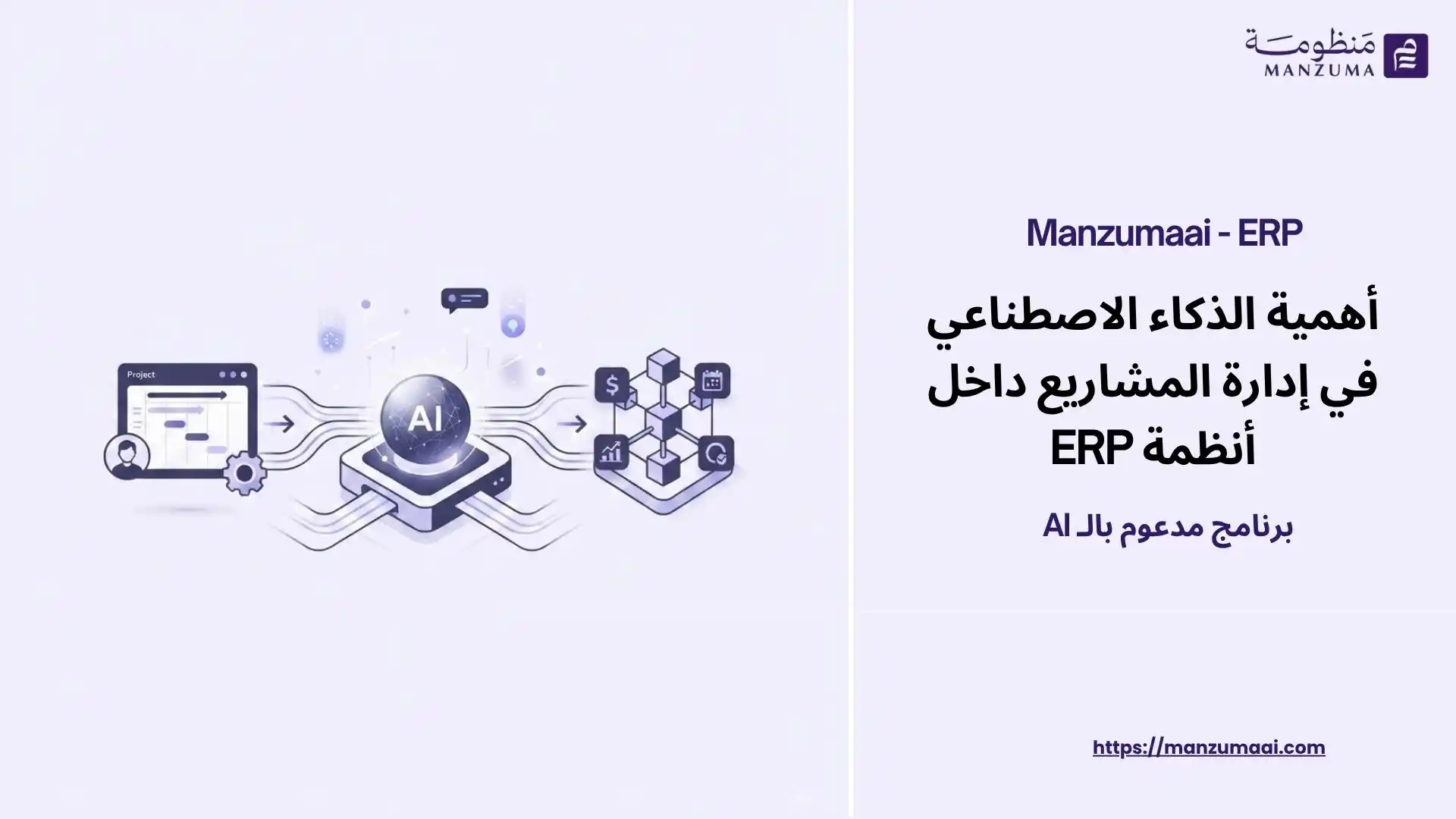
Project management is no longer limited to spreadsheets, recurring meetings, and manual task tracking. Today, Artificial Intelligence (AI) in project management has become a powerful tool that helps businesses plan more accurately, reduce operational errors, predict risks, and optimize resource utilization.
As modern ERP systems continue to evolve, AI is no longer a standalone technology. Instead, it has become an integral part of a connected business ecosystem that links projects with accounting, inventory, procurement, human resources, invoicing, and reporting. This is where automation delivers real value—transforming repetitive manual processes into intelligent workflows that operate with greater speed, accuracy, and efficiency.
In this article, we explore how AI is transforming project management, its relationship with ERP systems, and how automation empowers organizations with better visibility, stronger control over costs, timelines, and overall project performance.
What Is Artificial Intelligence in Project Management?
Artificial Intelligence in project management refers to the use of intelligent technologies to analyze data, support decision-making, predict outcomes, and automate repetitive tasks throughout the project lifecycle.
Instead of relying solely on manual oversight, project managers can use AI to:
- Analyze project performance.
- Detect potential delays before they occur.
- Forecast future costs.
- Optimize resource allocation.
- Track tasks and deadlines.
- Generate real-time reports.
- Alert stakeholders to risks and project deviations.
Simply put, AI does not replace project managers. It enhances their ability to see the bigger picture, make data-driven decisions, and manage projects more effectively.
Why Businesses Need AI in Project Management
Many organizations face recurring project management challenges, including missed deadlines, budget overruns, communication gaps between departments, duplicated data entry, and limited real-time visibility into project status.
This is where AI becomes invaluable. It transforms everyday operational data into actionable insights. Rather than discovering budget overruns at the end of the month, AI-powered systems can identify warning signs early and notify management before issues escalate.
Instead of depending on manually compiled reports, organizations gain access to real-time performance indicators directly from their ERP platform.
Companies that adopt AI and automation gain stronger control over projects because they move from reactive management to proactive planning based on prediction, analysis, and continuous monitoring.
The Relationship Between AI and ERP Systems in Project Management
An ERP (Enterprise Resource Planning) system serves as the backbone of business operations by connecting multiple departments within a single platform. When AI capabilities are integrated into an ERP system, the platform evolves from a simple data repository into an intelligent business management solution.
In project management, projects are closely connected to other business functions, including:
- Accounting and finance
- Inventory management
- Procurement
- Human resources
- Invoicing
- Reporting
By integrating AI into ERP systems, organizations achieve a unified and data-driven approach to project management.
For example:
- If a project requires specific materials, the system can automatically connect project requirements with inventory and procurement data.
- If expenses exceed planned budgets, AI can instantly link financial records with reporting dashboards.
- If workforce allocation becomes inefficient, AI can analyze employee availability, attendance records, payroll information, and workload distribution.
- If management wants to assess project profitability, financial and operational reports can be generated from a single system.
This is the true value of an intelligent ERP solution: connected data, informed decisions, and complete operational visibility.
How Automation Supports Project Management
Automation involves converting repetitive processes into workflows that execute automatically within the system, minimizing manual intervention.
When automation is combined with AI and ERP software, project management becomes significantly more efficient and organized.
Examples of project management automation include:
- Creating purchase orders automatically when inventory levels fall below predefined thresholds.
- Sending notifications before task deadlines.
- Converting quotations into invoices automatically.
- Updating project status based on task completion.
- Generating recurring performance reports.
- Alerting management when budgets are exceeded.
- Linking expenses to the appropriate project automatically.
- Streamlining approval workflows between departments.
Automation saves time, reduces manual errors, improves team coordination, and ensures greater process consistency.
Key Applications of AI in Project Management
1. Intelligent Project Planning
AI can analyze historical project data to estimate timelines, costs, and resource requirements for future projects.
Instead of relying on assumptions, organizations can use actual business data from their ERP system to create more realistic project plans, prioritize tasks effectively, and reduce scheduling risks.
2. Resource Management Optimization
One of the biggest challenges in project management is assigning the right people to the right tasks at the right time.
AI evaluates factors such as:
- Employee availability.
- Workload distribution.
- Team skills and competencies.
- Working hours and productivity.
When connected to the HR module within an ERP system, AI provides valuable recommendations that improve workforce allocation and overall project efficiency.
3. Predictive Risk Management
Risk management is critical to project success.
AI can identify early warning signs such as:
- Delayed milestones.
- Increasing expenses.
- Material shortages.
- Reduced team productivity.
Rather than discovering problems after they occur, organizations receive early alerts that allow them to take corrective action before risks impact project outcomes.
4. Cost and Budget Monitoring
By connecting project activities with accounting and procurement systems, businesses can monitor project costs in real time.
AI analyzes spending patterns and compares actual expenses against approved budgets. If costs begin to rise unexpectedly, the system can provide alerts and insights to help management understand the underlying causes.
5. Real-Time Performance Reporting
Traditional reporting often consumes time and may contain inaccuracies.
AI-powered ERP systems enable organizations to generate instant reports on:
- Project progress.
- Financial performance.
- Resource utilization.
- Profitability.
- Budget consumption.
Beyond displaying numbers, AI helps explain what the data means and recommends potential actions.
6. Improved Cross-Department Collaboration
Projects often suffer when departments operate in isolation.
Procurement teams may not fully understand project requirements, accounting may lack real-time visibility into expenses, and management may struggle to obtain a complete operational view.
ERP systems bridge these gaps by connecting departments through shared data, while AI analyzes that data to improve communication, collaboration, and decision-making.
The Role of ERP in Connecting Projects with Business Operations
Managing projects efficiently becomes difficult when information is scattered across spreadsheets, emails, messaging apps, and disconnected software tools.
ERP systems solve this challenge by centralizing business data in one platform.
Within an AI-powered project management environment, ERP connects projects with:
Accounting and Financial Reporting
Track project costs, revenues, profitability, and financial performance accurately.
Procurement and Supplier Management
Monitor purchase requests, supplier invoices, procurement activities, and vendor relationships linked to specific projects.
Inventory and Warehouse Management
Track material availability, inventory movements, and stock shortages that may affect project delivery.
Human Resources and Payroll
Associate employee working hours, salaries, attendance records, and labor costs directly with projects.
Invoicing and Sales
Manage project billing, payment collection, customer invoicing, and revenue recognition within a unified system.
AI vs. Automation: What's the Difference?
Although often used together, AI and automation serve different purposes.
Automation executes predefined actions automatically, such as sending notifications, generating invoices, or updating task statuses.
Artificial Intelligence, on the other hand, analyzes data, identifies patterns, predicts outcomes, and recommends actions.
When combined within an ERP platform:
- AI analyzes and predicts.
- Automation executes and streamlines.
For example, AI may detect a potential project delay, while automation automatically creates follow-up tasks and sends alerts to stakeholders.
Benefits of AI in Project Management
Implementing AI-powered project management provides several practical advantages:
Reduced Administrative Work
Automate repetitive activities such as reporting, monitoring, notifications, and data entry.
Better Decision-Making
Base decisions on real-time insights and data analytics instead of assumptions.
Fewer Human Errors
Reduce manual mistakes in reporting, accounting, invoicing, and project tracking.
Complete Project Visibility
Access project status, costs, risks, resources, and profitability from a single dashboard.
Higher Productivity
Allow teams to focus more on execution and less on administrative tasks.
Stronger Operational Control
Use predictive alerts and real-time reports to address issues before they become costly problems.
How Manzuma Helps Businesses Manage Projects Intelligently
Manzuma provides a cloud-based ERP platform designed to streamline business operations through AI and automation.
The system connects:
- Accounting
- Invoicing
- Inventory
- Procurement
- Human Resources
- Reporting
- Project Management
into a single integrated environment.
Rather than managing projects across multiple spreadsheets and software tools, Manzuma delivers a unified view of project activities and business performance in real time.
With the support of Monjez AI, businesses can access reports, insights, and operational data faster, helping management transform information into smarter decisions.
Start Managing Projects Smarter with Manzuma
As businesses continue to embrace digital transformation, AI in project management is becoming a necessity rather than a luxury.
When combined with ERP software and automation, AI helps organizations improve planning, reduce risks, optimize resources, and gain greater control over project performance.
Manzuma brings all these capabilities together in one cloud-based ERP platform, enabling businesses to manage projects, finances, inventory, human resources, and operations more efficiently.
If you're looking for a smarter way to manage projects and scale your business, start your free trial with Manzuma today and discover how AI-powered ERP can transform the way you work.
Ready to Organize Your Business?
Try Manzuma free for 14 days — no credit card, no commitment.